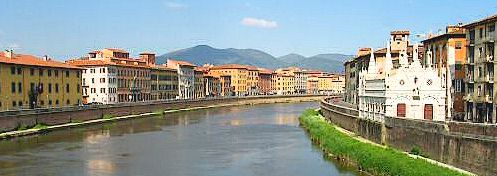
| Pisa is, of course, famous first and foremost for its "leaning tower", but the entire architectural complex of which the tower is a part is extremely interesting and attractive. Pisa is situated on the Arno, six miles from the sea, on a fertile plain. The walks along the banks of Arno here are as beautiful as in Florence, if not more so, and the town is packed with architectural gems. There are two important festivals, both taking place in June: | |||
|
|||
| Palio of San Ranieri on 17 June (the day of St. Ranieri, patron saint of Pisa), the four districts of Pisa (San Martino, San Francesco, Sant’Antonio, and Santa Maria) compete in a boat race, with each boat containing eight oarsmen, on the Arno for the “paliotto”, the prize. The race is held on the Arno along an upstream stretch of 2 km. On the night before, the famous Luminara is held in which the Pisans hang thousands of candles from the buildings along the river. Thousands of locals crowd along the banks of the Arno to see the fireworks at midnight. | ![]() |
||
|
|||
| Gioco del Ponte (Battle of the Bridge) on the last Sunday of June when teams from the two banks of the Arno, Tramontana (north) and Mezzogiorno (south) grapple with one another on the Mezzo Bridge. The six teams from the two banks challenge each other to push a 70 ton cart on a 50 meter rail over the opponent’s line. | ![]() |
||
|
|
|||
|
Art and architecture of Pisa |
|||
|
|||
|
The six arcades, the base on which they are placed and the belfry above them subdivide the Tower into eight segments, known as orders. The interior order is animated by a band of blind arches placed on half columns. Underneath the arches are lozenged rhomboid decorations inlaid with coloured marbles, each containing a rosette in relief at the centre. The wall facing is interrupted by narrow round-arched lancet windows and, to the west, by the only door of access: a rectangular opening framed by an architrave. Above the architrave a falcate arch with a carved archivolt rests upon two capitals in continuation of the piers, forming an aedicule containing a fourteenth-century bust of the Madonna and Child. At the sides of the portal there are friezes with decorations showing animals, imaginary beasts and ships. The cylindrical belfry which caps the Tower, of a smaller diameter than the floors below, bears an external decoration composed of closed and pierced lunettes, which rest alternately on pedestals and columns, whereby under every pedestal (bearing two closed lunnettes) there is a door, while the single pierced lunnettes supported on columns are lengthened to form windows. The belfry is reached via a narrow spiral stair, and in turn allows access to the top of the tower by way of a stair cut into the wall. The architect of the TowerAn inscription to the right of the entrance door records the date on which construction of the Tower began. A.D. MCLXXIV. CAMPANILE HOC FUIT FUNDATUM MENSE AUGUSTI (in the month of August, A.D. 1174, this bell tower was founded). This evidence is confirmed in the contemporary chronicles of Bernardo Maragone. The name of the architect, however, is not recorded. Vasari identified him as Bonanno Pisano but recent research points to Diotisalvi - the architect of the Baptistery. The name Diotisalvi occurs in a document of 1174 and there are evident affinities between the structure of the Baptistery and that of the Tower. The 'double' structure based on a correlation between interior and exterior is very similar in the two buildings. Another, perhaps more likely, candidate is Biduino, who was active at that time in the area of Pisa. The decorations of the base order are very similar to Biduino's most well-known work. However, there are no corroborating documents and the identity of the architect of the Tower remains to be resolved.
|
|||
|
|||

Panzano
is an attractive hill town halfway between Florence and
Siena.
Festa
della Stagion Bona, a mediaeval parade and
entertainment takes place on Liberation Day, 25 April.
